The Internet Has Erased Almost All Information Asymmetry, Knowledge Is Available Everywhere — Why Do Most People Still Fail to Achieve Significant Breakthroughs?
Have you ever found yourself scrolling late at night and stumbled upon:
Buffett’s portfolio holdings, Musk’s first-principles manuscripts, Yale’s full open courseware, how to start a one-person company, algorithm interview question sets…
In that moment, you’ve definitely had this illusion:
The internet has erased information asymmetry. Knowledge is everywhere. The only difference between me and the elite is just a little bit of luck.
But:
Even if you had all this information laid out right in front of you, you would most likely remain, for your entire life, average.
The so-called “internet information equality” has never been an express lane for class mobility. It is the internet age’s most deceptive narrative for maintaining class stability.
Deconstructed from first principles, the essence of a personal breakthrough in life is not “acquiring information,” but rather the ability to build a complete system that “converts information into decisions and consistently achieves positive outcomes.”
What the internet has erased is merely the most front-end “physical barrier to information access.” Every subsequent link in the chain blocks a vast number of people.
The Lies of Information Equality:
It assumes that all content on the internet is usable, valid information. That is far from true.
The First Barrier: Signal-to-Noise Ratio
Shannon’s A Mathematical Theory of Communication:
Information is that which reduces random uncertainty. The core prerequisite for effective information transmission is a sufficiently high signal-to-noise ratio.
When online information noise grows exponentially, the effective signal gets drowned out by a massive volume of redundant content.
Valuable information becomes a needle in a haystack.
This is Gresham’s Law in action:
Zero-cost, high-emotion, low-threshold junk information can be produced infinitely; high-cost, high-cognitive-threshold, deep, effective information gets naturally squeezed out of mass distribution channels.
It’s like dropping a single droplet of pure water into ten thousand tons of sewage — you will never get to drink clean water.
(Attention is the most precious asset of this era.)
The Second Barrier: Algorithms and Cognitive Limits
The filter bubble theory and the echo chamber conclusion:
The core objective of algorithms is user retention and engagement, not personal growth. Content that can reshape your cognition and help you achieve a leap forward is often counterintuitive, dry, and challenges your entrenched worldview — it does not favor user retention and will never be algorithmically promoted.
Humans are naturally prone to confirmation bias. This was discovered by Wason as far back as 1960 in his classic four-card selection task.
We actively gravitate toward information that aligns with our existing beliefs and instinctively reject content that contradicts our entrenched views — even when the latter holds the key to changing our lives.
Therefore:
Because of algorithms, even when high-value information sits out there in the open, the vast majority of people will go their entire lives without ever seeing it.
Just like Muggles can never discover the existence of the wizarding world.
You scroll through short videos all day and can come across hundreds of “wealth codes” and “top-tier thinking”…
But the information density and decision-making value of proactively digging through a 300-page industry deep-dive research report, or grinding through a classic economics original text — the former simply cannot compare.
Even if you cross this barrier, you will most likely get stuck at the second choke point:
You Simply Don’t Have Enough Cognitive Bandwidth to Digest It
Mullainathan, in Scarcity, proposed the theory of cognitive bandwidth:
Human attention and rational thinking computational power are rigid resources with a physiological upper limit.
When a massive amount of attention is consumed by fragmented entertainment like short videos, the bandwidth left for deep reading and systematic thinking is close to nothing.
The daily reality of the vast majority of people:
Work drains most of their mental energy. After work, they can only squeeze out a bit of dopamine by scrolling through short videos.
You simply have no spare computational power to deconstruct and internalize high-value information.
Kahneman’s dual-system theory in Thinking, Fast and Slow further explains the inevitability of this dilemma:
The brain is naturally biased toward low-energy, effortless fast thinking, and instinctively resists high-load, logic-demanding slow thinking.
And all understanding and absorption of high-value information can only be accomplished through slow thinking.
Baumeister’s ego depletion theory corroborates this as well:
Willpower is a finite reserve. Every act of self-control and deep thinking drains this reserve. (Chronic indulgence in entertainment and distraction will directly exhaust your mental strength to resist the brain’s inertia and settle down for deep learning.)
E.g., it’s like a computer whose background processes are completely occupied by streaming dramas and games — the remaining computational power simply cannot run anything like an ML program.
Take reading Poor Charlie’s Almanack as an example:
Some people finish it and only remember a few motivational quotes; others can deconstruct the underlying logic of his multiple mental models, and even map it onto their own decision-making to make corrections. The question has never been who can access this book, but who has enough cognitive bandwidth to complete the deconstruction and internalization.
Even if you manage to free up enough cognitive bandwidth, you will most likely get stuck at the third barrier:
Your Innate Talent Is Insufficient to Understand Valuable Information
Human intelligence naturally follows a normal distribution:
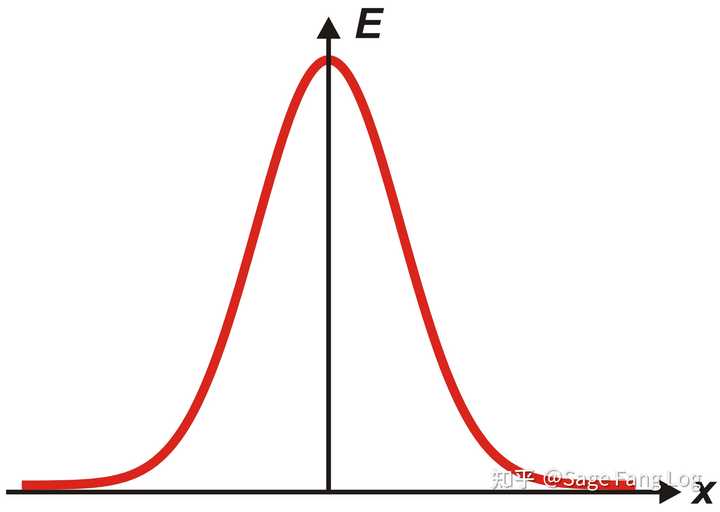
Medium intelligence accounts for the majority. People with strong abstract reasoning, logical inference, and systematic deconstruction abilities are inherently a minority. (Let’s say starting from 2.5 standard deviations out.)
Roll call:
First-principles thinking, associative analysis, abstract reasoning, logical modeling, multivariate analysis… all of these have nothing to do with people within one standard deviation of the mean.
Critical thinking is an even scarcer ability in the population. The proportion of people — even among the highly educated — who can distinguish correlation from causation, independently falsify logic, and step outside intuitive biases to make rational judgments, is extremely low.
The Dunning-Kruger effect reveals the truth:
The vast majority of people are stuck on “Mount Stupid,” unaware of where their cognitive blind spots lie. With a superficial grasp, they consider themselves thoroughly enlightened.
(Socrates from over 2,000 years ago remains unattainably lofty.)
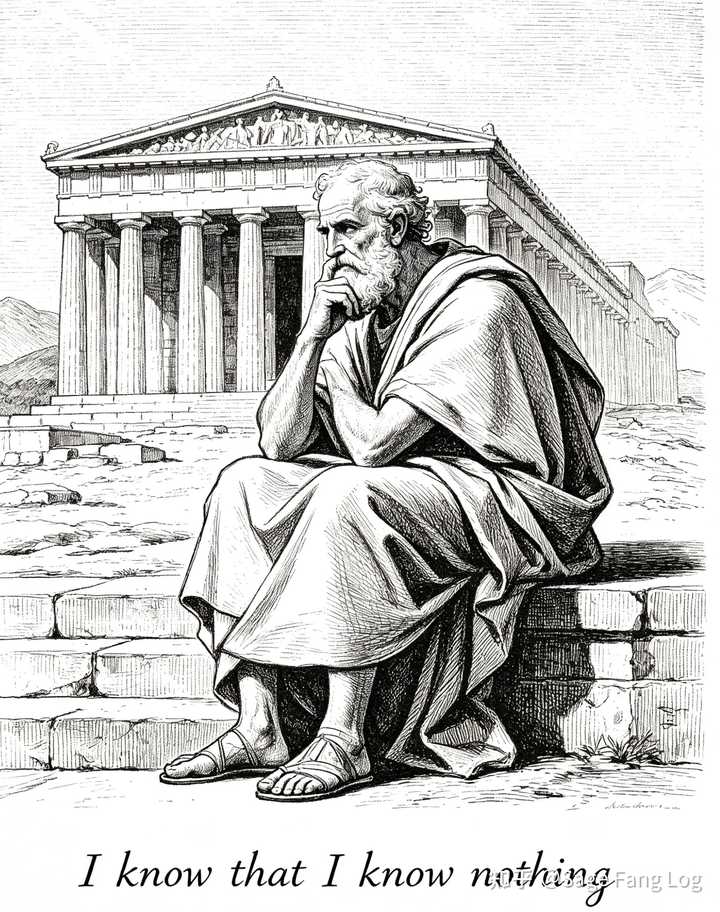
This is not a question of willingness to understand. Innate intelligence itself constitutes a rigid threshold for penetrating foundational logic.
E.g., take the release of a new policy document for the new energy industry:
Some people are completely unaware. Some dismiss it with disdain. Some only see the surface-level signal of “state support.” And some can deconstruct the supply-demand landscape behind the policy, the technological iteration pathway, the core variables of industry chain profit distribution — and even anticipate the industry inflection point and profit from it. This is not an information gap; it is a gap in abstract modeling and multivariate analysis capabilities.
Even if you cross all the preceding barriers, that information may still not transform into your capability, much less do real work in the world.
The Unity of Knowing and Doing — The Chasm Most People Can Never Cross

Constructivist learning theory has long made it clear:
Knowledge cannot be passively copied like a file. You must, grounded in your own existing cognition, actively deconstruct the premises, verify the applicable boundaries, reconstruct the mental framework, and extrapolate and reuse it across different scenarios — only then can you truly internalize it as your own thinking habits and decision-making ability. Merely reading, memorizing, and reciting will keep it forever as someone else’s insight, having nothing to do with your own life.
E.g.:
You memorize every theory of swimming, but without getting into the water and swimming hundreds of times, you will never learn to swim. You read every methodology on entrepreneurship, but without getting your hands dirty and running a single model validation, it will forever remain armchair theorizing.
And what lies behind the disconnect between knowing and doing is:
Loss aversion: The pain of failure and loss is perceived far more intensely than the pleasure of equivalent gain.
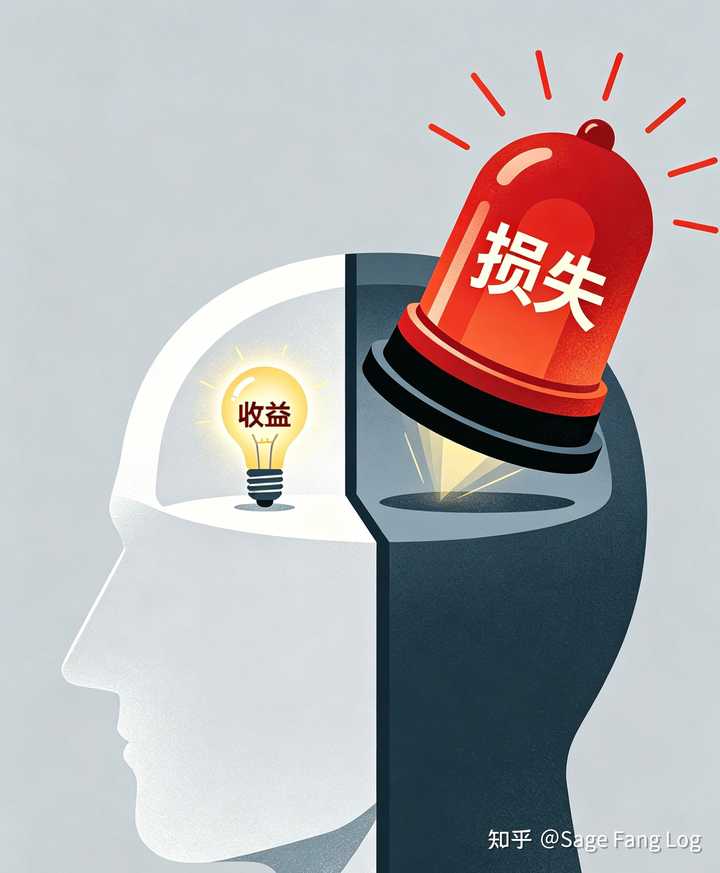
Most people, out of fear of failure and inability to endure short-term losses, never dare to take that first step into practice.
Deliberate practice theory also shows:
Real practical capability must be built through sustained deliberate practice in the learning zone, with immediate feedback and continuous correction. Logical reasoning in your head will always be an idealized model, while reality is filled with uncertainty. E.g., a wind tunnel can never replace a test flight.
This is why many people, even with high cognitive ability, remain high-cognition paupers their entire lives.
Now you finally understand why Jensen Huang’s catchphrase is “How hard could it be?” (Take note.)
However. What comes next is the ultimate barrier:
The Intergenerational Cultural Capital Gap That Information Equality Can Never Erase
Bourdieu’s theory of cultural capital, put forward in Distinction, pierces through the secret of class:
The true barrier of class has never been whether you can search for information. It is the thinking patterns, risk preferences, and behavioral habits shaped by family upbringing — all of these are forms of cultural capital that cannot be acquired through a search engine.
Global intergenerational mobility research all confirms the same fact:
Even disregarding the chasm of financial capital, the probability of a person from a lower-class background crossing into the upper class relying solely on internet information remains extremely low.
E.g., take the same private equity investment opportunity: a person from a working-class family will hesitate repeatedly because losing that money would affect their entire family’s livelihood, while someone with sufficient margin for trial and error can decisively seize the opportunity.
(This is the difference between survival capital and investment capital.)
This has never been about information asymmetry. It is about the gap in cultural capital and investable capital.
Enough With the Rant. Here’s the Hands-On, Step-by-Step Playbook:
Restructure Your Information Input System. Crank Up the Signal-to-Noise Ratio.
Replace your TikTok/Douyin with a curated, high-quality feed. Start by training your algorithm — actively cultivate it. If your Bilibili feed has gone to waste, you’re basically watching it like Douyin. Try to “surf scientifically” — access different sources of information. At minimum, read one book per month. Uninstall Weibo. Don’t chase entertainment hot takes. Don’t get lost in grand narratives. Don’t pick sides before the full picture of events has emerged.
Manage Your Attention Like You Manage Your Money.
Reserve 1–2 hours of “deep thinking time” every day. During this window, stay away from all entertainment and trivialities. Only do deep reading and systematic thinking.
Don’t set yourself the grandiose goal of “reading one book a day” right from the start. Instead, begin with the smallest closed loop: “Read 10 pages of an original text each day, deconstruct 1 core logic.” (Just like quitting smoking or drinking must be done gradually, otherwise you’ll suffer severe withdrawal symptoms.)
This lowers the barrier to action and avoids the paralysis that grandiose goals trigger. Use long-term compounding to fight against the instinct of hyperbolic discounting.
Deliberately Train Your Abstract Modeling and Multivariate Analysis Abilities. Pierce Through the Surface of Information and Touch the Essence of Things.
Every time you encounter a piece of high-value information, don’t start by memorizing the conclusion. Instead, first ask yourself three questions:
What are its underlying assumptions?
Where are the boundaries of its applicability?
Can its foundational logic be transferred to my own context?
E.g., when you study first-principles thinking, don’t just memorize the phrase “derive from physical laws from the ground up.” Instead, deconstruct the complete logic of how he uses this principle to make decisions:
First, strip away all non-core variables and discern the essence of the matter. Then, starting from that essence, reconstruct the solution. Next, apply this logic to your own work, investments, and life — practice it repeatedly.
Two additional points:
Always distinguish correlation from causation. Always ask one more “why” rather than “what.”
Adopt an MVP Mindset and the Corresponding Execution Ability.
(Perfectionism is the biggest trap.)
Never wait until you are “fully ready” to act. Instead, use the closed loop of “input → deconstruct → small-scale practice → feedback → iterate” to immediately convert knowledge into capability.
E.g., you’ve learned a foundational marketing logic. Immediately use that logic to run a minimum-cost experiment: write a piece of copy, do a small-scale promotion, get real feedback, and then refine your understanding based on that feedback.
How hard could it be?

A small tip:
Leverage loss aversion. Set yourself a “cost of inaction” to force yourself to take that first step.
Actively Accumulate Your Cultural Capital.
Information equality cannot give you the intergenerational cultural capital passed down through families — but you can actively work to compensate for it:
Find the circles in your field. Not to schmooze, but to learn their decision-making logic and ways of operating. Actively accumulate your trial-and-error capital. Use controllable costs to run more experiments and build your own real-world experience. Construct your own multiple mental models. Integrate the foundational logic of different disciplines into your decision-making system.
In conclusion, the internet has never created a utopia of “information equality” for ordinary people.
It has only given ordinary people an illusion: that as long as you can search for the same information as the elite, you possess equal opportunities…